HOA Architectural Review Denial: What to Check and Ask Next
A document-first process for understanding an HOA design-review denial, checking the stated rule, improving an application, and preserving an appeal record.
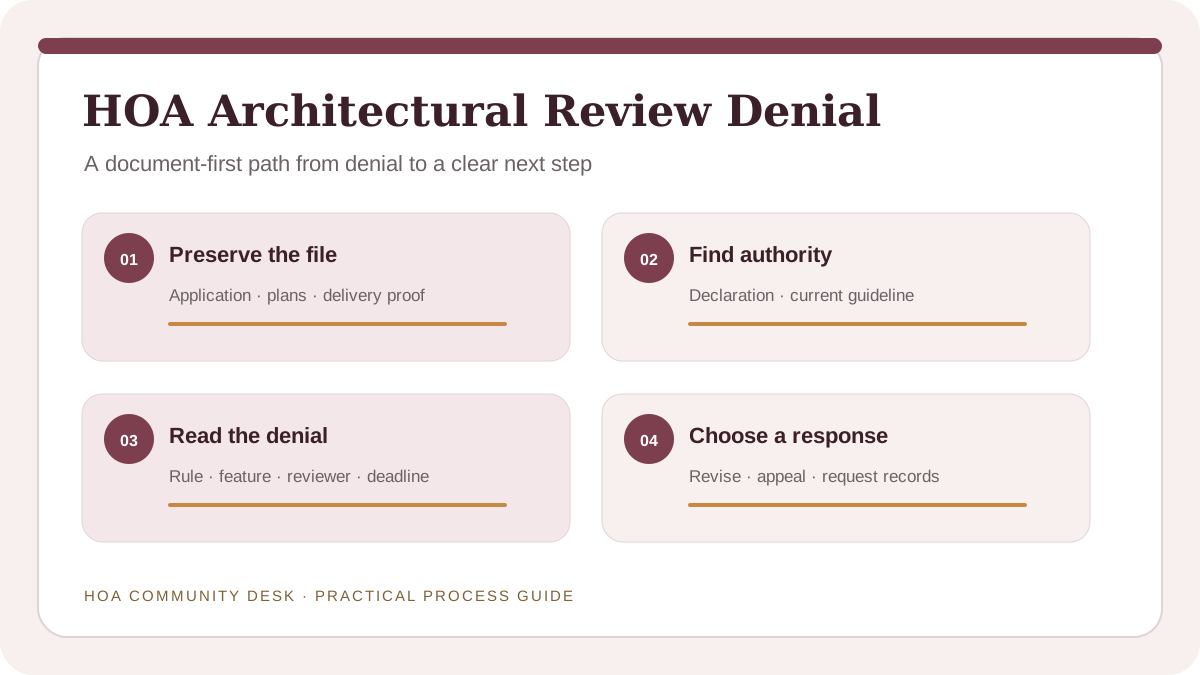
An architectural-review denial can stop a planned roof, fence, paint change, shed, window, landscaping project, or accessibility improvement. The first useful step is to slow down and identify what the association actually decided. A short email saying “not approved” may leave important questions unanswered: which version of the plan was reviewed, who had authority, what governing standard applied, what part failed, and what process allows a reconsideration or appeal.
This guide offers a practical document-first workflow. It is not a national statement of legal rights. Association authority, application deadlines, deemed-approval rules, appeal rights, owner access, and remedies vary by state and by recorded documents. Florida’s current HOA statute, for example, limits architectural review to authority stated or reasonably inferred in the declaration or authorized published guidelines and requires denials to identify the relied-on rule and the specific aspect that does not conform. Those provisions apply to Florida HOAs; do not assume another state has the same language.
Preserve the complete application and decision
Save the application exactly as submitted, including plans, dimensions, materials, colors, site drawings, photos, contractor details, signatures, and proof of delivery. Keep the association’s receipt confirmation, any request for more information, the review committee’s notice, and the final written decision. Record the date the application was complete if the documents distinguish complete applications from initial submissions. Do not rely only on a portal screenshot that may later change.
If approval was discussed by phone or in a meeting, send a calm written summary asking the association to confirm the formal decision and the date it was issued. Avoid beginning construction on the assumption that a favorable comment from a manager, committee member, or neighbor constitutes approval. The governing documents may assign authority to a committee or board and may require a written decision.
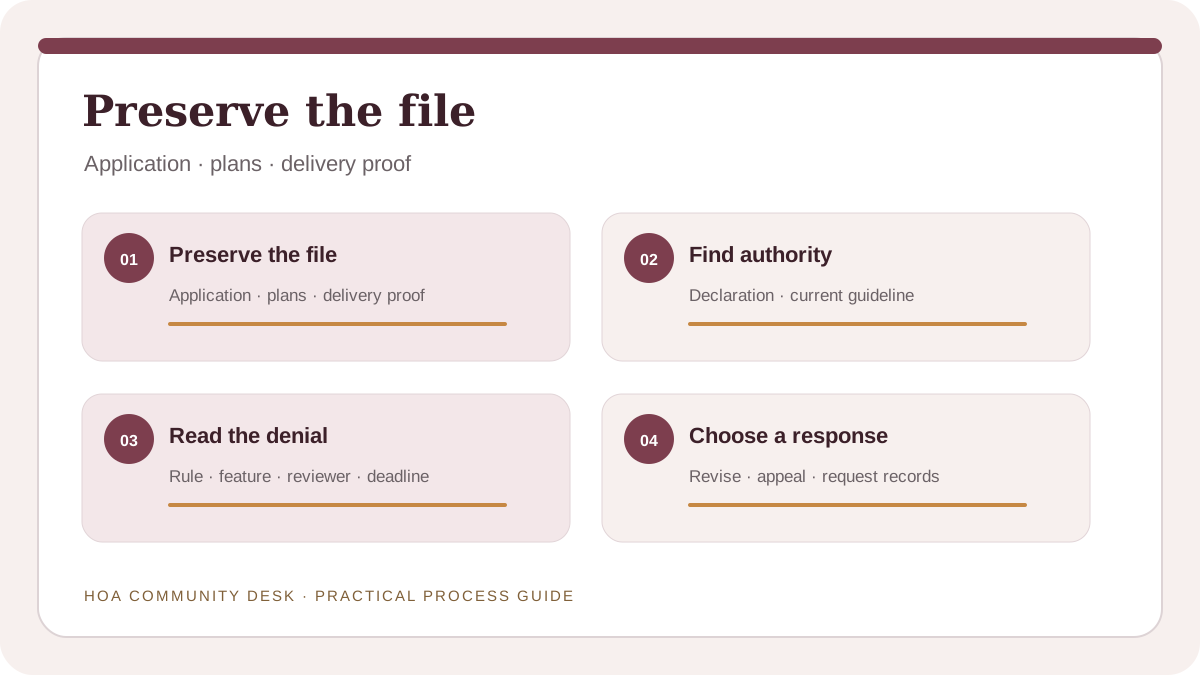
Find the source of the review authority
Locate the declaration, architectural-control article, current design guidelines, application instructions, board resolutions, and any committee charter. Check how the guideline was adopted and whether it is the version in effect when the application was submitted. Identify the provision that authorizes review of the feature in question. A general preference for a uniform appearance may not answer whether the association has authority over a particular location, material, or improvement.
Separate association approval from public permits. A city or county building permit does not necessarily replace HOA approval, and an HOA approval does not replace a permit or code inspection. Each process has its own authority, application, conditions, and deadlines. Make a list of required approvals and do not let one agency’s response stand in for another’s.
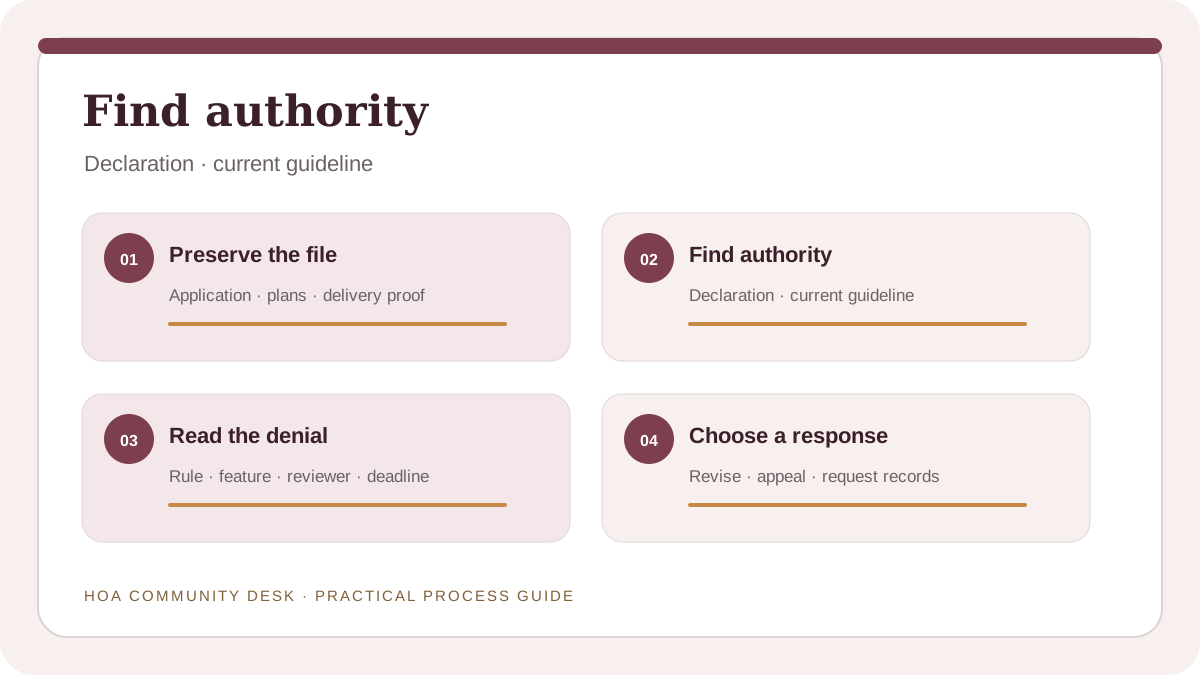
Read the denial for four concrete details
- Decision-maker: Does the notice identify the board, committee, or other body that made the decision and show that it had authority under the documents?
- Rule: Does it cite the actual covenant, guideline, or adopted standard relied on, rather than only saying “not harmonious” or “not in keeping”?
- Plan feature: Does it identify the specific drawing, location, dimension, material, color, or other part that fails the standard?
- Next step: Does it explain how to request reconsideration, revise and resubmit, appeal, inspect relevant records, or meet a deadline?
These questions help you understand the decision; they do not prove that every association in every state must provide each item. For Florida parcel owners, § 720.3035 contains a specific written-notice requirement after a denial, including the relied-on rule or covenant and the particular aspect that does not conform. Elsewhere, check the controlling statute and documents before deciding what the association was required to include.
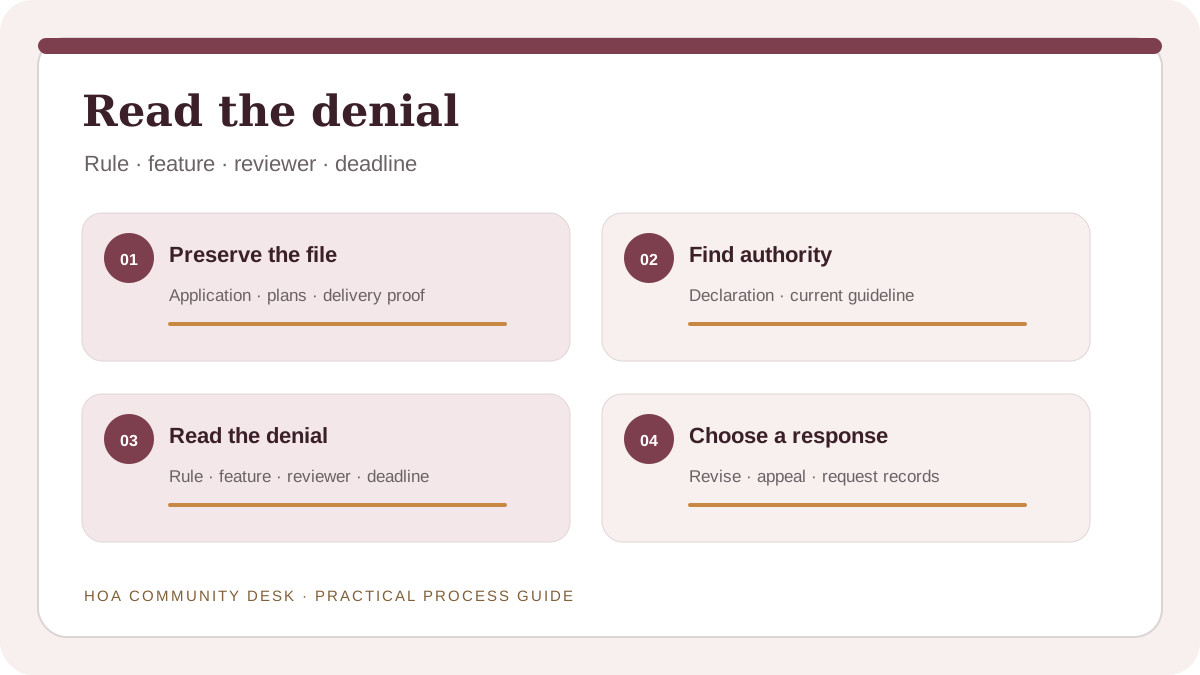
Compare the rule with the submitted plan
Build a simple comparison table with three columns: exact rule text, feature the HOA says is nonconforming, and supporting evidence. If the concern is a setback, show the boundary, easement, required distance, and measured proposal. If it is color or material, identify the guideline language, manufacturer, finish, and any approved alternatives. If the concern is visibility, include photos from the viewpoints the rule actually addresses. This makes a response specific without turning it into a personal argument about fairness.
Check whether the guideline gives a range or choices. If it lists approved materials, colors, dimensions, or placement options, compare your proposal to each option. Some state laws limit an association’s ability to reject a choice expressly allowed by its declaration or authorized guidelines. Florida’s statute includes such a protection for options provided in those documents. That is a Florida-specific rule, not a guarantee that every state treats design options the same way.
Ask focused questions before resubmitting
A useful inquiry requests clarification, not a fight. Ask the association to identify the exact provision, the plan element that does not meet it, the evidence or measurement used, the current guideline version, and the person or body authorized to decide an appeal. If the denial lists several concerns, ask whether addressing one feature would resolve the application or whether separate issues remain. Request any applicable reconsideration deadline and submission method in writing.
Do not send a broad demand for every architectural file in the community as the first step. Start with the governing provision, current criteria, your own application record, the written decision, and any nonconfidential process documents that local law makes available. If you need comparators, identify a narrow category of similar approvals and dates. Privacy or records-access limits may prevent release of another owner’s full file, but the association may be able to explain its standard or provide appropriately redacted information.
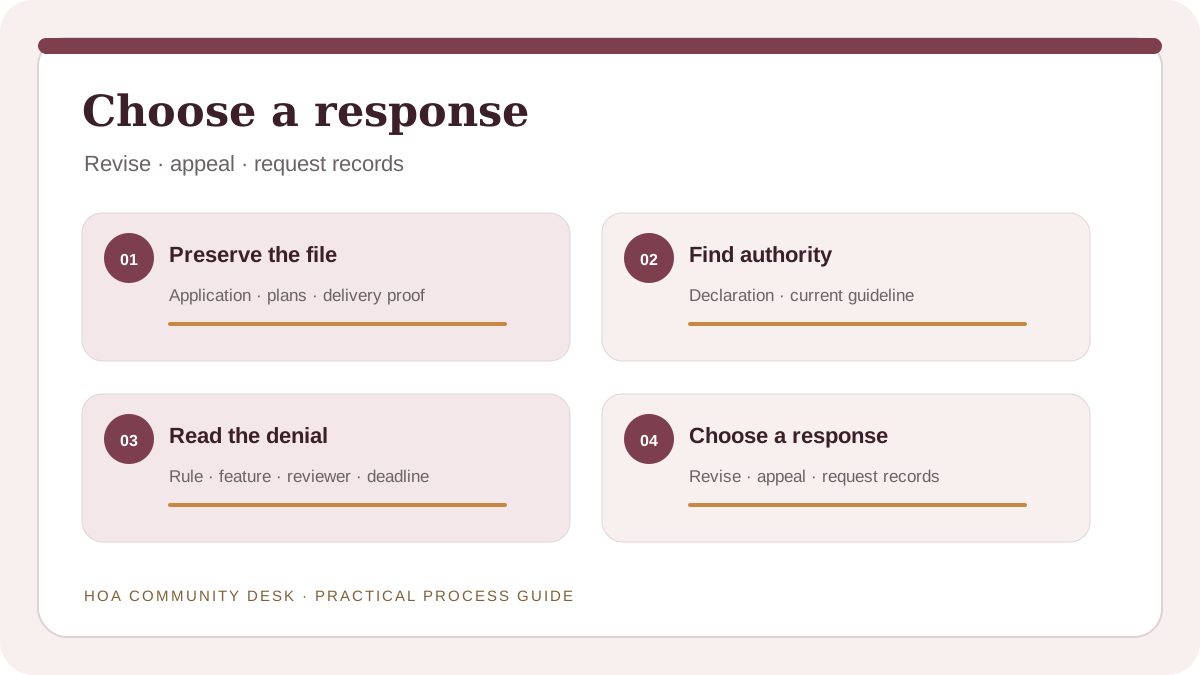
Decide whether a revision, appeal, or both makes sense
A revision may be faster when the denial identifies a practical design issue and a small change would meet a clear standard. An appeal may make more sense when the rule was misread, the decision-maker lacked authority, a permitted option was rejected, the same written standard appears to be applied differently, or the process missed a required step. Some associations allow both, but do not assume that a new application pauses an appeal deadline. Calendar each route separately until the governing process confirms otherwise.
When you revise, label every change on a new plan set and include a short response matrix connecting each denial point to the corrected drawing or explanation. Keep the original application and make clear which version is now under review. If you appeal, identify the decision being challenged, the exact rule or process issue, the requested outcome, and the documents supporting your position. A concise record is easier for a reviewer to assess than a long narrative about the history of the board.
Keep accommodation and protected-rights issues on a separate track
Some design requests involve disability-related access or another protected legal right. Those matters may require a distinct accommodation or modification process, limited handling of sensitive information, and a different legal analysis from aesthetic review. State and federal rules can differ based on the facts and housing arrangement. If a request is connected to disability, religious practice, fair housing, or a statutory protection for a specific improvement, identify it expressly and seek qualified advice rather than treating it as an ordinary color or appearance appeal.
Likewise, certain states protect defined improvements such as solar systems, satellite antennas, or hurricane-protection products. Those statutes may set scope, conditions, or procedures. Do not assume that a feature is automatically exempt from all design requirements; identify the specific statute, product, location, and constraints and check whether it applies to the association and property.
Plan for construction only after approval is clear
Before signing a nonrefundable contract or ordering custom materials, confirm the written approval covers the final scope and plans. Check whether the association attached conditions, approval expiration, inspection requirements, or a need to submit a revised detail. Confirm local permit status separately. If the board changes a condition, request the updated decision in writing and keep it with the approved plans.
If work has already begun, avoid concealment or escalation. Photograph the current condition, preserve the application history, identify any safety or weather-related issue, and get local advice quickly if a stop-work demand, fine, lien threat, or court deadline arrives. A new application may help resolve design concerns, but it may not cure every dispute or suspend enforcement automatically.
Worked example: a fence rejected for “appearance”
An owner submits a site plan and a manufacturer cut sheet for a rear fence. The committee replies that the style is “not harmonious,” without naming a guideline or pointing to a feature. The owner first checks the declaration and current design manual, then confirms whether the committee can decide fence applications. The documents list two permitted fence styles but say nothing about the requested color. The owner sends a written request identifying the approved-style option, asks which color standard applies, and requests the applicable appeal date. If the association identifies a measurable issue, the owner can revise the submission; if it relies on a rule outside its authority, the owner can raise that point through the stated appeal process. The example illustrates how to clarify the decision, not what a court would decide.
What a useful closing record contains
Keep one folder with the operative rule and guideline, each dated plan version, proof of submission, the committee or board notice, correspondence, appeal or revised application, final written approval or denial, permit documents, and proof of any required conditions. Use file names that show the date and version. A future board, contractor, buyer, or reviewer should be able to tell which plan was approved and what limitations applied without reconstructing the history from personal inboxes.
For a related response workflow, see the HOA violation appeal guide.
Not legal advice. Architectural authority, review deadlines, appeal rights, records access, protected improvements, and remedies depend on governing documents and local law. HOA rules and state statutes vary — check your governing documents and local law.
Sources and further reading
- Florida Statutes § 720.3035 — Architectural control covenants and parcel owner improvements (2026)
- HUD — Fair Housing Act overview
- HUD — Reasonable accommodations and modifications
Sources are used for general governance, fair-housing, debt-collection, or dispute-resolution principles. State-specific HOA law may impose additional or different requirements.
Frequently asked questions
What should an HOA architectural denial letter include?
Check the governing documents and state law. Florida law specifically requires a denial to identify the relied-on rule or covenant and the part of the proposed improvement that does not conform. Other states may use different requirements.
Can I start construction while an HOA appeal is pending?
Do not assume you can. Confirm whether written approval is required before work, whether an appeal pauses enforcement, and what permits or safety rules apply. Get the answer in writing before starting.
Can an HOA reject a design option expressly listed in its guidelines?
The answer depends on the documents and local law. Florida law limits restricting options provided in the declaration or authorized published guidelines; this rule should not be generalized to other states.
Should I appeal or submit a revised architectural application?
Compare deadlines and the reason for denial. A focused revision can solve a clear design mismatch, while an appeal can address authority, rule interpretation, or process concerns. Keep both deadlines until confirmed.
Does HOA approval replace a building permit?
No. HOA review and government permitting are separate processes. Confirm both approvals and any conditions before construction.