Can an HOA Board Vote by Email? Check the Rules Before Counting Replies
How to distinguish email discussion from a valid HOA board action, check state law and governing documents, and create a clear meeting and records trail.
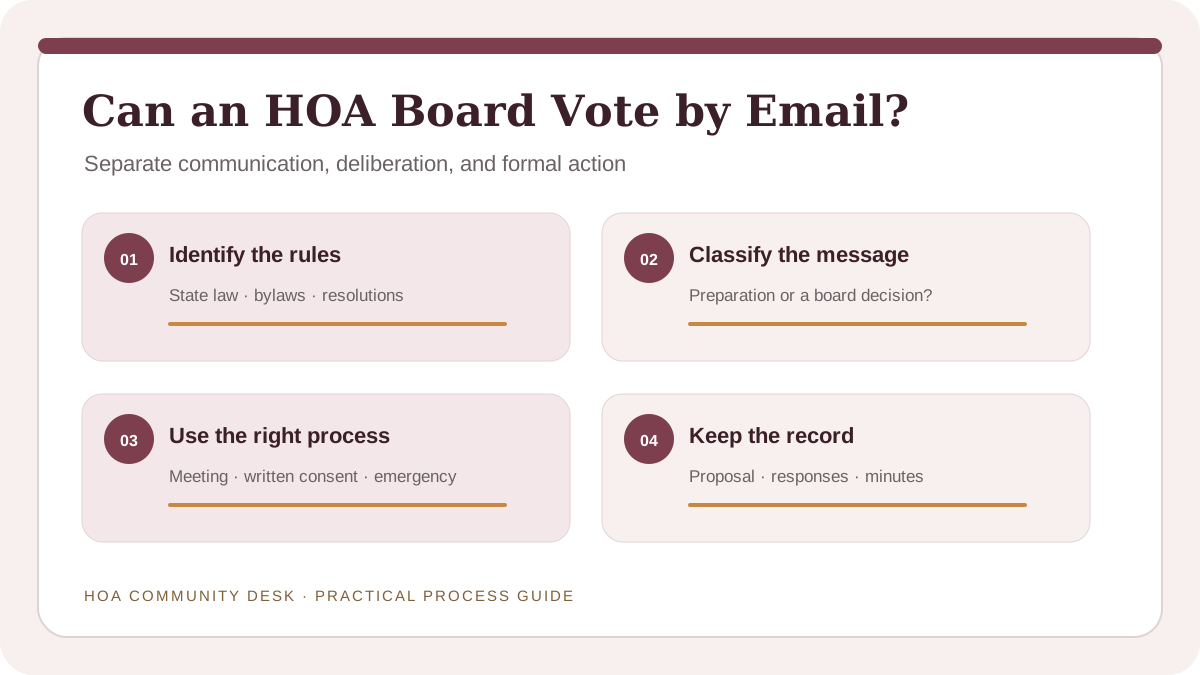
A message that says “reply yes by Friday” can feel like the fastest way to settle an HOA issue. But a string of email replies is not automatically a valid board vote. The answer depends on the state’s community-association and nonprofit-corporation laws, the association’s declaration and bylaws, any adopted meeting rules, and the kind of action being considered. A board may be allowed to exchange information electronically while still being required to make its decision at a properly called meeting.
Start with the distinction that prevents most confusion: communication is not the same thing as formal board action. Directors can often circulate a draft, ask for factual corrections, gather availability, or send background materials by email. Whether a quorum may deliberate or decide in that channel is a separate legal question. Calling a message an “informal poll,” “consensus check,” or “ratification” does not determine its legal effect.
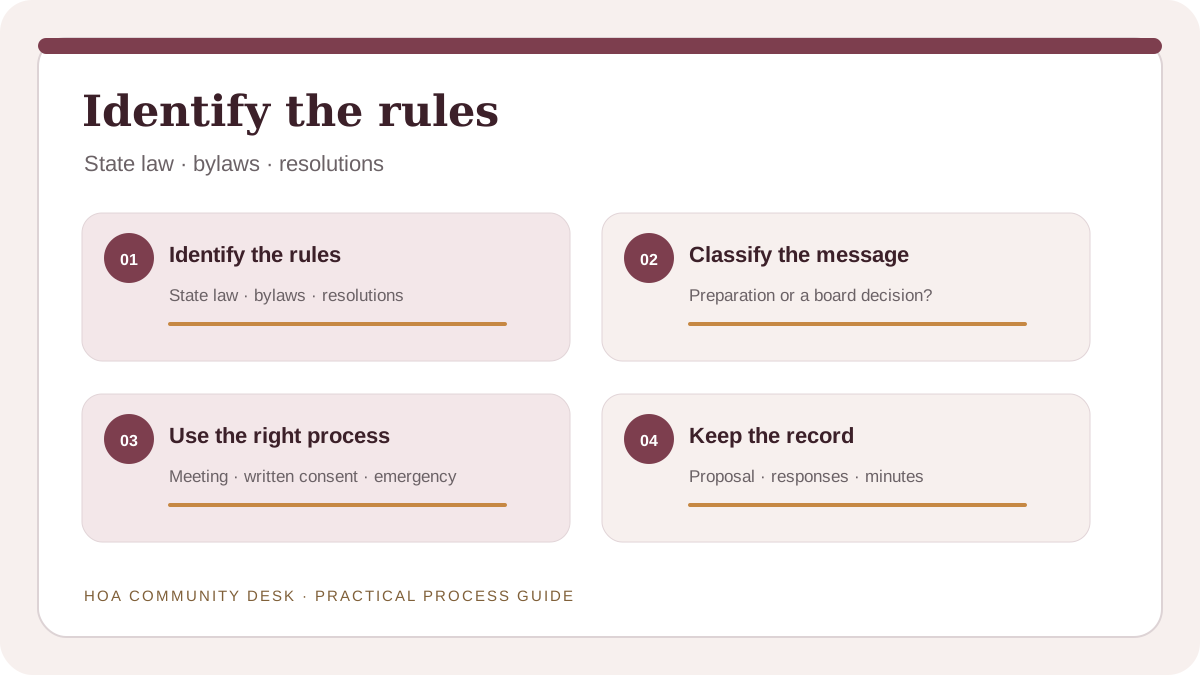
Find the rule that governs this association
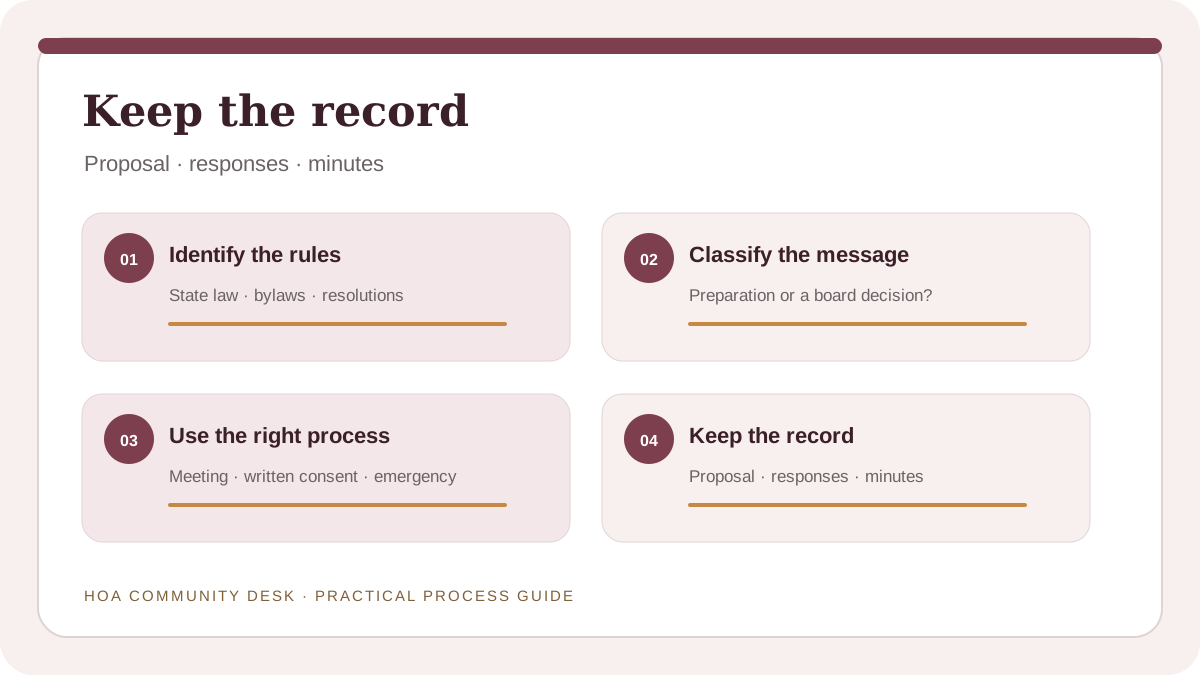
First identify the association type and state. A planned community, condominium, cooperative, and nonprofit corporation may fall under different statutes. Then read the current declaration, articles, bylaws, board resolutions, electronic-communications policy, and meeting rules. Search for terms such as board meeting, notice, quorum, action without a meeting, electronic communication, written consent, emergency, and minutes. Check amendments and effective dates; a copied handbook may no longer match the recorded documents.
Do not assume the general nonprofit statute answers the question by itself. A community-association act may impose additional open-meeting requirements or may override a bylaw provision. A document may also authorize electronic action only if statutory conditions are met. The useful question is not “Do our bylaws mention email?” but “Which controlling rule applies, and what steps does it require for this specific action?”
Three common legal patterns
State rules do not follow one national model. Some statutes allow directors to communicate electronically but expressly prohibit casting a vote on association business by email. Florida is a clear example: its Homeowners’ Association Act says directors may use email to communicate but may not cast a vote on an association matter via email. It separately requires board meetings to be open to members, subject to listed exceptions. For a Florida HOA, a yes-or-no email tally should therefore not be treated as the board’s final vote.
Other states provide a defined action-without-a-meeting process. Texas Property Code Chapter 209, for example, addresses board action outside a meeting and requires each board member to have a reasonable opportunity to express an opinion to all other board members and to vote. Texas law also reserves a substantial list of decisions for an open meeting with prior owner notice, including fines, assessment increases, special assessments, enforcement actions (with narrow exceptions), architectural-control appeals, annual-budget approval, and several other high-impact actions. An action taken outside a noticed meeting must be summarized orally and documented in the next regular or special board-meeting minutes. Section 209.0051 has association-scope rules and further details, so this route is not permission to copy a Texas process into another state or to disregard the declaration, bylaws, or other applicable law.
A third pattern requires unanimous written consent or another formal record for action without a meeting. Requirements may include delivering the exact proposed resolution to every director, allowing a response period, preserving each director’s consent, and placing the record with the minutes. An email thread may or may not meet those requirements. The board must verify the actual statute and document language before relying on this route.
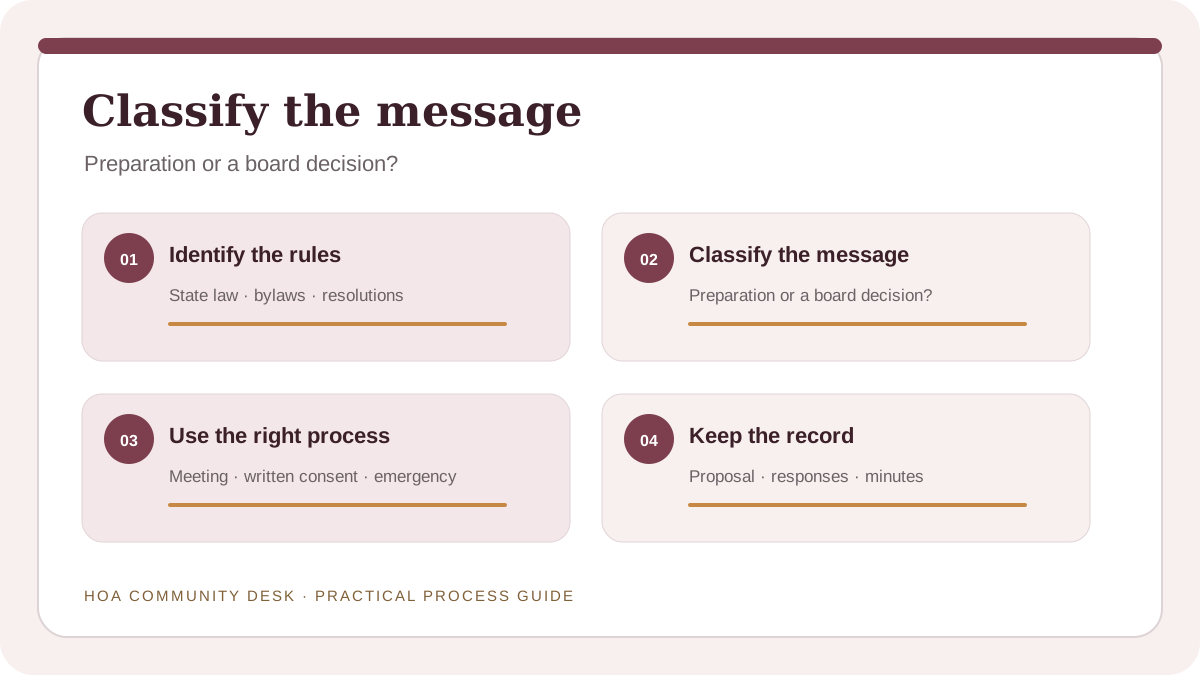
Separate preparation from deliberation and decision
Routine administrative exchange is different from a substantive decision. A manager might email the board a contractor’s revised insurance certificate, confirm a meeting time, or ask directors to identify factual errors in a draft agenda. Those messages usually prepare the board to act; they do not decide whether to approve the contract or change a rule. Keep them brief and factual when the matter must be handled at a meeting.
Risk increases when directors debate options, bargain over terms, signal how they will vote, or build a majority through serial replies. Even if no one writes “motion” or “approved,” the communication may function as deliberation or action under the governing rule. Avoid using one-on-one forwarding chains to assemble a quorum’s views while keeping the substantive exchange away from the process members are entitled to attend. Do not split one discussion across text, messaging apps, and email to try to make it informal.
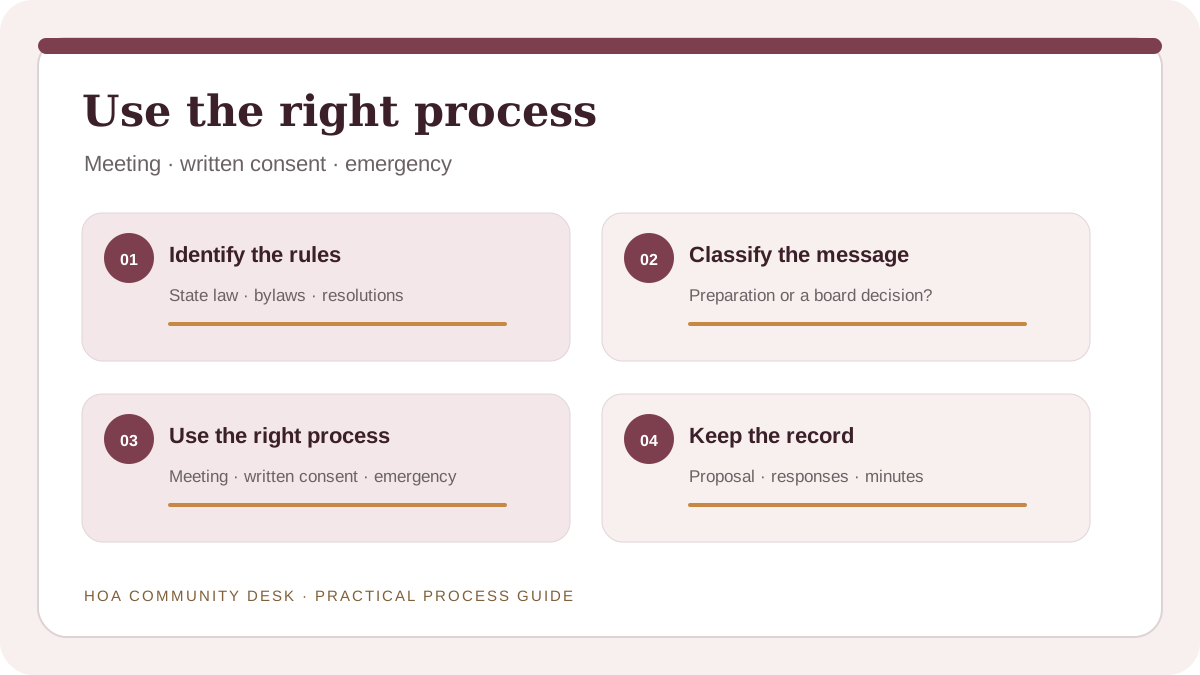
Use a decision checklist before sending a ballot-style email
- Classify the action. Is this routine administration, board deliberation, a formal board vote, a member vote, an emergency response, or a written-consent procedure?
- Identify the authority. Record the statute and document provisions that permit the proposed route. If the sources conflict or the action is significant, ask qualified local counsel before circulating a vote request.
- Check who must participate. Determine whether every director must receive the proposal, whether a quorum is enough, whether unanimity is required, and how vacancies, abstentions, conflicts, or nonresponses are treated.
- Send the exact motion. If action without a meeting is permitted, circulate the precise resolution, supporting materials, voting deadline, and required instructions to every eligible director. Do not infer assent from silence.
- Protect notice and access rights. Confirm whether notice, an agenda, an open meeting, an owner-comment opportunity, or an emergency finding is required.
- Preserve the record. Save the proposal, delivery information, each response, the final result, and the minutes or written-consent record in the association’s official system, subject to applicable retention and access rules.
When a meeting is the safer route
If the law is unclear, the board can usually move the decision to a properly noticed meeting rather than trying to rescue a disputed email vote later. Put the specific action on the agenda, distribute the documents in advance, confirm quorum, allow any owner participation required by law, state the motion clearly, and record each director’s vote or abstention as required. An in-person meeting is not always necessary; some jurisdictions allow video or telephone meetings if the required participation and access standards are met.
For a time-sensitive issue, check whether the statute or bylaws define an emergency procedure. A real emergency route may be limited to particular conditions and may require prompt follow-up notice, documentation, or ratification. Convenience, a looming vendor deadline, or a preference not to convene a meeting is not necessarily an emergency. If an action cannot wait, counsel can help identify the lawful path rather than assuming email is the only option.
Why “we will ratify it later” can fail
Later approval does not automatically erase an invalid process. The later meeting may be able to make a new decision, but whether it validates earlier conduct depends on the authority, facts, governing documents, third-party reliance, and state law. If the board has already directed a vendor to begin work, sent an enforcement notice, or represented to owners that a policy changed, a new vote may not undo the consequences.
If an email vote already happened, preserve the full record and avoid editing the thread to make it appear more formal. Identify exactly what was communicated, whether anyone acted in reliance, and whether a deadline or payment is pending. Put the matter on a properly noticed agenda and ask counsel whether the board should make a fresh prospective decision, correct a communication, or take another step. Do not describe the old vote as valid or invalid until the controlling rules are checked.
Build a practical board email policy
A short policy can reduce accidental decisions. It can say which channels the board uses, what kinds of factual or scheduling messages are appropriate, when discussion must move to a meeting, how urgent notices are routed, which system holds official records, and who may communicate an adopted decision. The policy should not promise that every email is private or exempt from disclosure. Record-access and retention laws vary, and messages about association business may need to be preserved.
Use subject lines that identify the purpose without implying approval. Label attachments with the meeting date and agenda item. Ask directors to avoid “reply all” debate on substantive matters unless the applicable law and board policy clearly allow that method. Keep owner information and sensitive records in approved, access-controlled systems. A clear process protects directors and residents because everyone can identify when preparation ends and a decision begins.
Worked example: the roofing proposal
A manager emails three roofing bids and asks directors to reply with a preferred contractor. One director says “Bid B,” another raises concerns about the warranty, and a third agrees with Bid B. Before treating that as approval, the manager should check the governing procedure. If the state bars email voting, the responses are preferences for the meeting packet, not an award. If action without a meeting is permitted, the association still needs to satisfy its exact notice, proposal, participation, vote, and record requirements. The board may instead schedule a special meeting, compare scope and warranty terms in an accessible packet, hear owner comments if required, and record a motion and vote.
Questions residents can ask without assuming the result
An owner who sees a decision announced after an email exchange can ask which procedure authorized action without a meeting, where the final resolution or minutes are maintained, and whether the board intends to place the issue on a meeting agenda. Keep the request specific and factual. Records access, redactions, and deadlines differ by state. If a deadline or property right may be affected, seek advice promptly rather than relying on an online summary.
For notice, quorum, and agenda planning, see the HOA meeting notice guide.
HOA rules and state statutes vary — check your governing documents and local law. This guide is general education, not legal advice. The Florida and Texas examples are limited to those states and may change; verify current law before acting.
Sources and further reading
- Florida Statutes § 720.303 — Association powers, board meetings, and records (2026)
- Texas Property Code, Chapter 209 — Texas Residential Property Owners Protection Act
- Colorado Division of Real Estate — HOA Forum: Voting and Proxies
Sources are used for general governance, fair-housing, debt-collection, or dispute-resolution principles. State-specific HOA law may impose additional or different requirements.
Frequently asked questions
Can an HOA board vote by email?
It depends on the state law and governing documents. Florida prohibits directors from casting a vote on association matters via email, while other states provide different action-without-a-meeting procedures. Verify the rule for the specific association before counting replies.
Can HOA directors discuss a proposal by email before a meeting?
Some administrative or factual exchanges may be allowed, but substantive deliberation can trigger open-meeting or action rules. Check local law and keep email from becoming a workaround for a meeting the members are entitled to attend.
Does a later board meeting automatically validate an email vote?
No universal rule guarantees that. A later vote may be a new decision, but its effect on prior conduct depends on the law, documents, facts, and third-party reliance. Preserve the record and get local advice.
Can an HOA use a written consent without a meeting?
Some jurisdictions allow a formal written-consent process, often with specific delivery, participation, unanimity, timing, or recordkeeping requirements. Do not assume ordinary email replies satisfy those requirements.
What should an HOA board minutes record after a vote?
Follow the governing rule. Florida law, for example, requires minutes to record each director’s vote or abstention on each matter voted on at a board meeting. Other jurisdictions may differ.